 All News
2017: Training outstanding doctoral students at IMPRS-IS—Interview with Leila Masri
Celebrating ten years of Cyber Valley in 2026
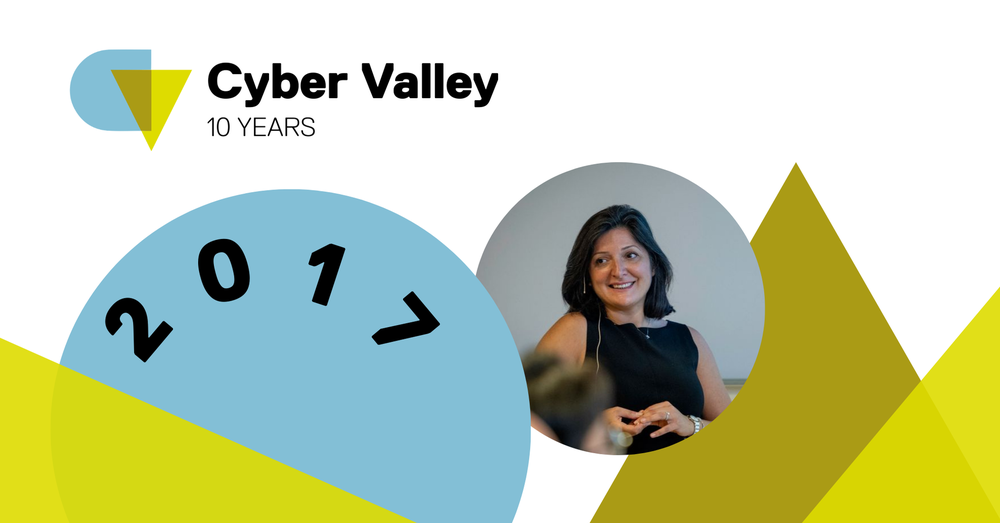
In 2016, important actors from science, industry, and politics founded the Cyber Valley Consortium, which became the first Innovation Campus in Baden-Württemberg. Ten years on in 2026, we're revisiting the most important milestones from the last decade. Each month, we'll focus on a particular year since Cyber Valley's beginning.
This month, we’re looking back to 2017 when Cyber Valley’s graduate school, the International Max Planck Research School for Intelligent Systems (IMPRS-IS), was founded. IMPRS-IS trains outstanding doctoral students from around the world and supports them in their PhD research so they can use their AI expertise to build a better future in Europe.
Leila Masri has been the scientific coordinator at IMPRS-IS since 2017. She has supported its growth into one of Germany’s largest doctoral programs, now comprising more than 300 doctoral researchers and nearly 100 faculty members. Committed to fostering diversity in science, she also contributes to initiatives broadening access to research, including the CaCTüS and RIGI internship programs in Tübingen and Stuttgart. In the following interview, she reflects on IMPRS-IS’s founding and what makes the graduate school unique.
When you helped launch IMPRS-IS in 2017, what vision did you have for the program, both for the students and for the broader research community?
As a scientist myself, I completed my PhD in Tübingen and Kiel and later worked as a postdoctoral researcher in Austria. Throughout my academic career, I have been deeply committed to supporting students and teaching, an interest I further developed by earning a university teaching diploma from the University of Stuttgart. When Michael J. Black and Katherine J. Kuchenbecker at the Max Planck Institute for Intelligent Systems (MPI-IS) launched IMPRS-IS in 2017 and were looking for a coordinator, it felt like a natural fit. My vision was to help build a welcoming international community where doctoral researchers and faculty could connect, exchange ideas, and thrive together, while providing an environment in which excellent research can flourish. It has been incredibly rewarding to see this vision come to life.
Looking back over the past years, which moments or milestones felt particularly defining for IMPRS-IS, and why do they stand out to you personally?
Looking back, one of the defining milestones was how quickly IMPRS-IS grew. Our original goal was to build a doctoral program with around 100 PhD students over six years, so reaching that number in less than two years was incredibly encouraging. Over those six years, we ended up recruiting more than 400 doctoral researchers, making IMPRS-IS one of the largest yet youngest doctoral programs in Germany.
Furthermore, we had long wanted to organize industry visits so our students could see how research works outside academia and exchange ideas with researchers working in industry. Interestingly, this happened quite naturally through our alumni, who started hosting us at companies like Bosch, with a visit to Amazon coming up soon; both also partners in Cyber Valley. That organic development has been particularly rewarding to see.
From your perspective, what is unique about IMPRS-IS? What distinguishes it from other doctoral training programs?
What makes the program special is how it brings together the Max Planck Institute for Intelligent Systems with the Universities of Stuttgart and Tübingen. This gives doctoral researchers access to both cutting-edge research infrastructure and strong academic networks. The focus on intelligent systems naturally connects AI, robotics, engineering, and related fields, and the close ties to the Cyber Valley ecosystem help link fundamental research with industry and innovation.
At the same time, the structured doctoral program—with thesis advisory committees, Think & Link gatherings, annual boot camps, and professional development opportunities—provides valuable support to its doctoral students as well as to its senior scientists. Furthermore, beyond all the institutional and program strengths, what truly sets IMPRS-IS apart for me is its people and culture. It genuinely feels like a home: a place defined by trust, support, warmth, and collaboration.
That strong sense of community, alongside research excellence, is what makes IMPRS-IS truly unique.
IMPRS-IS students come from a broad range of backgrounds, but do you think that they share any particular mindsets or qualities?
Yes—although IMPRS-IS students come from very different academic, cultural, and personal backgrounds, I do think they share common mindsets and qualities. The program is highly international, with doctoral researchers from over 35 countries, more than 60% non-German speakers, and about 28% female researchers, alongside a wide range of academic backgrounds and expertise. That diversity enriches the research they conduct, as people approach problems in different ways and contribute their own personal touch to the research they pursue.
There’s a noticeable culture of empathy, openness, and mutual support—people are approachable, willing to exchange ideas, and genuinely invested in each other’s academic and personal success.
What aspects of the program are you personally most proud of today?
Honestly, I don’t think I can point to one single aspect in isolation—what I’m most proud of is really the people who make IMPRS-IS what it is. The program’s success stems from the collective effort and commitment of many individuals: the strong guidance from our spokesperson Katherine J. Kuchenbecker, the steady support of the executive board and coordination office, and the genuine engagement of faculty members and scholars who are consistently willing to support doctoral researchers. That level of dedication creates an environment where doctoral candidates feel encouraged, guided, and valued. We can now measure this success: IMPRS-IS has attracted top-tier scientists from around the world, involves nearly 100 faculty members, hosts over 300 doctoral candidates, and has graduated more than 150 PhD students since 2017.
Combined with the program’s diversity, interdisciplinarity, and culture of openness and mutual support, IMPRS-IS is not just a strong academic program—it is a place where people can thrive both scientifically and personally.
To celebrate Cyber Valley's ten-year anniversary, we'll be sharing a variety of content across our website and social media channels reflecting on milestones from the last decade. Stay tuned for the next installments!
Company Information

Related Articles

2023: Three new AI institutes at Cyber Valley



2022: Hector Foundation supports founding of ELLIS Instit...